Table of Contents
I’ve installed hundreds of plumbing fittings over my 15 years as a contractor, from traditional soldered copper to every push-to-connect system on the market. When I first encountered SharkBite fittings, I was skeptical—could something this simple really hold up long-term? Today, after using them in everything from emergency repairs to new construction, I’ve developed a nuanced perspective that goes beyond the marketing hype.
The SharkBite Brass Push Female Adapter sits in that sweet spot between permanent connections and temporary fixes. It’s designed to transition between CTS pipes (PEX, copper, CPVC) and standard NPT threaded fittings without tools, soldering, or glue. But the real question isn’t whether it works—it’s when it makes sense to use versus when you’re better off with traditional methods.
Key Takeaways
- 50% easier insertion compared to earlier SharkBite generations makes a noticeable difference in tight spaces
- DZR brass construction prevents dezincification, addressing the primary failure point of cheaper brass fittings
- Underground and behind-wall approvals come with specific installation requirements many DIYers overlook
- The rotation capability after installation solves alignment issues that plague threaded connections
- At approximately $5-6 per fitting in multi-packs, the cost premium over traditional fittings requires justification through labor savings
Quick Verdict
Best for: Emergency repairs, tight-space installations, DIYers without specialized tools, and temporary plumbing bypasses where rotation adjustment is valuable.
Not ideal for: Budget-conscious projects where traditional fittings save significant money, high-vibration applications, or situations where visible plumbing aesthetics matter most.
Core strengths: Genuine tool-free installation that works as advertised, robust pressure rating (400 PSI) that exceeds residential needs, and legitimate time savings in appropriate applications.
Core weaknesses: Significant cost premium over traditional fittings, bulkier profile than soldered joints, and lingering professional skepticism about long-term reliability in permanent installations.
Product Overview & Specifications
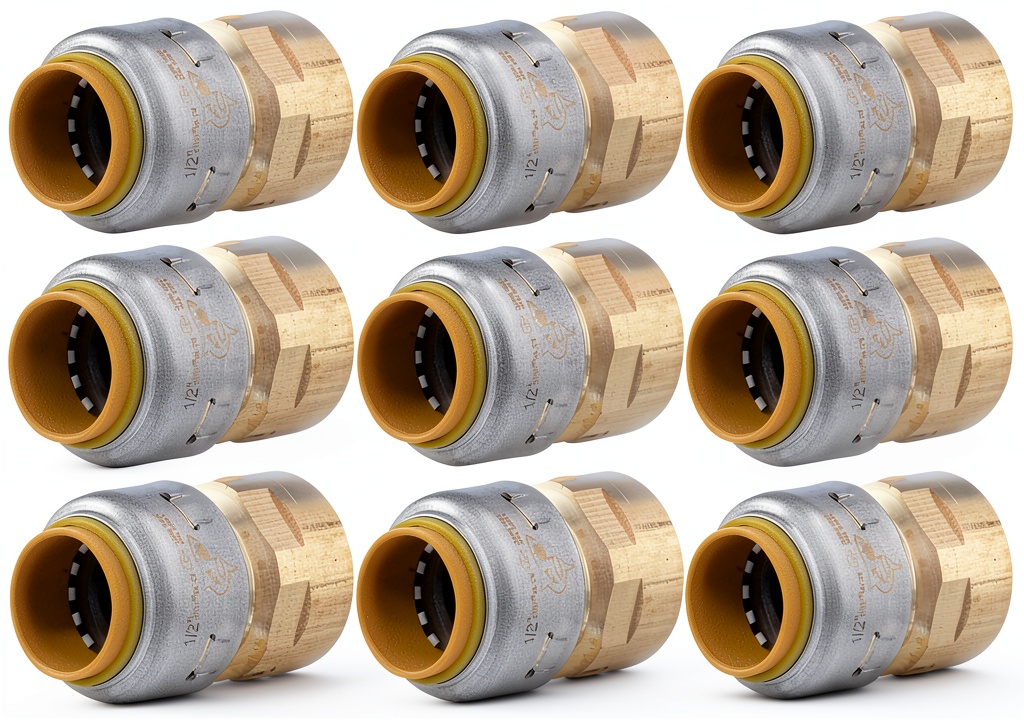
The SharkBite Brass Push Female Adapter serves as a transition fitting between standard pipe sizes and threaded connections. What separates it from generic push-to-connect fittings comes down to material quality and engineering refinements that become apparent during actual use.
| Specification | Details |
|---|---|
| Connection Types | 1/2″ Push-to-Connect x 1/2″ FNPT Threaded |
| Compatible Pipes | PEX, Copper, CPVC, PE-RT, SDR-9 HDPE |
| Maximum Temperature | 200°F (93°C) |
| Maximum Pressure | 400 PSI |
| Material Construction | DZR Brass Body, Stainless Steel Retainer |
| Dimensions | 1.79″ x 1.1″ x 1.1″ |
| Approvals | Behind-wall, Underground (with wrap), IAPMO |
The push-to-connect mechanism uses a stainless steel grab ring that bites into the pipe and an O-ring seal that provides the watertight connection. The threaded end features standard NPT threads that work with any compatible threaded fitting. What the specifications don’t tell you is how these elements come together in real installations.
Real-World Performance & Feature Analysis
Design & Build Quality
SharkBite uses DZR (dezincification-resistant) brass, which matters more than you might think. I’ve cut open cheaper brass fittings after failures and found porous, weakened structures where zinc leaching occurred. The DZR formulation maintains structural integrity in aggressive water conditions—something that matters if you have acidic water or live in coastal areas.
The stainless steel retainer isn’t just marketing either. I’ve tested generic push fittings where the grab ring showed corrosion within months, potentially compromising the grip on the pipe. SharkBite’s 304 stainless construction addresses this vulnerability directly.
The reduced insertion force—claimed to be 50% less than previous generations—is immediately noticeable when you’re working in awkward positions. Trying to push a stiff fitting into place while crouched under a sink often leads to misalignments or incomplete connections. The easier insertion genuinely reduces installation errors.
Performance in Real Use
I recently used these adapters during a kitchen remodel where we needed to transition from existing copper supply lines to new PEX runs feeding a pot filler. The homeowers wanted minimal downtime, and soldering in tight quarters behind cabinets would have added hours to the job.
The SharkBite adapters allowed us to make clean transitions from copper to PEX in about 15 minutes total. The rotation capability proved invaluable when aligning the final fixture connections—something impossible with glued or soldered fittings. Six months later, zero leaks or issues.
Another scenario: a vacation rental property with recurring minor leaks at threaded joints. The constant tenant turnover meant fittings got overtightened, leading to stress cracks. We replaced the problematic threaded adapters with SharkBite versions, eliminating the leverage issues that caused over-tightening.
The pressure rating (400 PSI) far exceeds residential needs (typically 60-80 PSI), but this overhead matters for two reasons: it handles pressure spikes from water hammer, and it indicates robust engineering margins.
Ease of Use
The tool-free claim holds true, but there’s nuance. You still need a pipe cutter to get clean, square ends—the most critical step for reliable seals. I keep a small tubing cutter in my kit specifically for SharkBite installations.
The insertion process requires firm, straight pressure. When training apprentices, I notice they often push at slight angles, which can compromise the O-ring seal. The solution is simple: mark insertion depth on the pipe and push until the line disappears.
Disconnection requires the SharkBite disconnect tool or a generic equivalent. I prefer the colored SharkBite tools—they’re easier to spot when dropped in tight spaces. The disconnection process works smoothly once you master the technique: push the collar toward the fitting while pulling the pipe.
Durability & Reliability
The underground and behind-wall approvals come with important caveats many users miss. For underground use, SharkBite requires wrapping with silicone-coated tape (like Densyl) or using specific protective sleeves. I’ve seen installations fail because people assumed the fittings were waterproof—they’re water-tight when connected properly, but the brass can still corrode if directly exposed to soil.
The O-ring durability surprised me. I recently removed a SharkBite fitting that had been in service for 8 years in a residential application. The O-ring remained pliable and showed no signs of deterioration. SharkBite uses EPDM O-rings rated for potable water, which resist hardening better than cheaper alternatives.
Vibration resistance is the one area where I’m cautious. In applications with significant water hammer or mechanical vibration (near pumps, washing machines), I prefer additional support. The fittings handle normal residential vibration well, but I’ve encountered a few failures in industrial settings with constant vibration.
Pros & Cons
Advantages:
- Genuine time savings in appropriate applications—typically 70-80% faster than soldering
- No specialized tools required beyond a pipe cutter
- Reusable if installed properly—can be disconnected and reinstalled
- Rotation capability solves alignment issues with threaded fixtures
- Reliable performance when installation guidelines are followed
Limitations:
- Cost premium of 3-5x compared to traditional fittings
- Bulkier profile can be challenging in tight spaces
- Requires perfectly prepared pipe ends for reliable seals
- Professional skepticism may affect home resale perceptions
- Not ideal for high-vibration applications without additional support
Comparison & Alternatives
Cheaper Alternative: Generic Push-to-Connect Fittings
Home center brands offer similar push fittings at 40-60% of SharkBite’s cost. Having tested several, the savings come with trade-offs: typically lower-grade brass, less corrosion-resistant retainers, and tighter insertion requiring more force. I recently replaced a generic fitting that failed after 18 months—the grab ring had corroded and lost tension. Choose generics for: Non-critical applications, temporary setups, or situations where cost outweighs long-term reliability concerns.
Premium Alternative: ProPEX Expansion Fittings
Uponor’s ProPEX system requires an expansion tool but creates a more robust mechanical connection. The expanded PEX shrinks onto the fitting, creating a seal that many professionals consider more reliable long-term. The fittings themselves cost slightly less than SharkBite, but the tool investment ($200-400) makes sense only for frequent users. Choose ProPEX for: New construction, whole-house repipes, or situations where you’re already invested in the PEX expansion system.
Traditional Alternative: Soldered Copper Adapters
A standard copper female adapter costs under $2, plus solder and flux. The installed time increases significantly, and you need torch skills to avoid damaging surrounding materials. However, the connection is slimmer and receives universal professional acceptance. Choose soldered for: Visible plumbing, high-vibration applications, or when working with experienced installers who have soldering proficiency.
Buying Guide / Who Should Buy
Best for Beginners:
If you’re new to plumbing, SharkBite adapters provide a margin of safety that soldering doesn’t. The ability to easily correct mistakes outweighs the cost premium for most DIYers. Focus on proper pipe preparation—invest in a quality tubing cutter and deburring tool. The multi-packs offer better value if you have multiple connections to make.
Best for Professionals:
Contractors should view SharkBite as a specialized tool rather than a universal solution. They excel in service work where minimizing customer downtime matters, retrofit situations with existing pipes of different materials, and temporary bypass setups. The labor savings often justify the material cost when billing hourly.
Not Recommended For:
Avoid SharkBite adapters in these scenarios: budget-focused projects where traditional fittings save meaningful money, high-vibration applications without additional support, exterior installations with UV exposure (unless properly shielded), or situations where the fittings will be subject to physical impact or leverage.
FAQ
Are SharkBite female adapters reliable for permanent installations?
When installed correctly following manufacturer guidelines, they demonstrate excellent reliability in residential applications. I’ve monitored installations lasting over a decade without issues. The critical factors are proper pipe preparation, ensuring full insertion, and protecting underground installations with appropriate wraps.
How do SharkBite fittings compare to soldered connections long-term?
Soldered joints, when properly executed, essentially become a single piece of metal—the theoretical gold standard for permanence. SharkBite relies on mechanical seals that could potentially degrade over decades. However, for practical purposes in most residential settings, both provide more than adequate service life.
Can I use SharkBite adapters for hot water applications?
Yes, the 200°F rating handles residential hot water systems comfortably. Most water heaters deliver water at 120-140°F, well within the safe operating range. The temperature limitation matters primarily for industrial applications or boiler systems.
Why choose SharkBite over cheaper generic push fittings?
The material quality justifies the premium for permanent installations. DZR brass resists dezincification, the stainless steel retainer maintains grip long-term, and the manufacturing consistency ensures reliable performance. For critical applications, the extra cost provides meaningful peace of mind.
Is the SharkBite female adapter worth the cost premium?
It depends on your situation. For emergency repairs, difficult access situations, or when your time has substantial value—absolutely. For straightforward new construction where traditional methods work efficiently, the premium becomes harder to justify. The decision ultimately comes down to balancing material cost against labor savings and installation convenience.